Apple TV, and the room it sits in
A native tvOS experience designed for a television rather than scaled up from a phone: easy to move around with the Siri Remote, and the viewer never loses their place.
Case study · Five surfaces
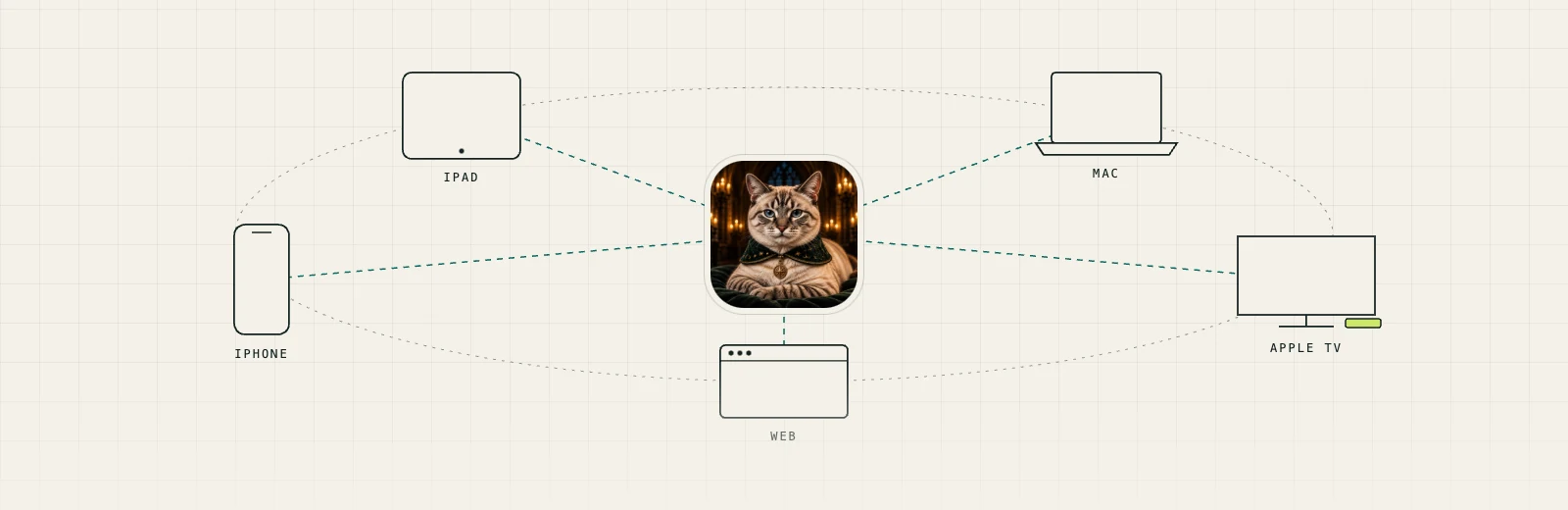
A private media system built for two people. It runs on iPhone, iPad, Apple TV, Mac and the web, from one shared codebase and one backend. The current build is Build 63, in TestFlight for iOS, tvOS and macOS. It is in daily use by one household on private TestFlight, and it has never been submitted to the App Store.
The brief
The starting point was not a feature list. It was lived context: what two people had watched together, what they had watched apart, and which of those things carried something worth keeping. A generic catalogue answers none of that, because the interesting information is not the film. It is whose memory it is.
So the product model came first and the software came second. Shared memories, with a view for each person and one for both together. A seasonal calendar. Dates that matter. A companion character with a written voice, sarcastic and fond, rather than a general assistant wearing a name.
The artwork was chosen by hand and approved as final. No automated process was permitted to regenerate or replace an accepted master. That rule exists because a system that can improve your artwork can also quietly lose it, and the pieces in this product are not interchangeable.
What was built
A native tvOS experience designed for a television rather than scaled up from a phone: easy to move around with the Siri Remote, and the viewer never loses their place.
Native SwiftUI on each, sharing one core architecture and build identity. Adaptive layouts including iPad multitasking, on-device dictation, keyboard navigation on the Mac, and accessibility behaviour for larger text, VoiceOver, Reduce Motion and increased contrast.
The strip of artwork Apple TV shows above the app, part of the Apple TV surface. It shows seasonal and special-event art at the right time of year.
A responsive experience carrying the same catalogue and invitations, with honest unavailable states rather than empty ones, and audio that never starts by itself.
One system underneath all five. That is the part that makes this a system rather than five apps with a family resemblance. A change lands in one place and reaches every surface, and seasonal moments appear on the right day.
The pace, stated precisely
The delivery history holds 202 commits and 990 tracked files at the Build 11 release candidate, the origin story as read on 3 September 2026, commit 18bfcb9, and the first and last of those commits are 21 hours and 50 minutes apart. Those figures are pinned to that commit rather than to a date, because the repository is still moving and a count taken on a Tuesday is wrong by Wednesday.
That figure is the repository, and it is not the whole job. Concept, product model, artwork selection and the seasonal rules were settled before the first commit existed, and none of that appears in a git log. The total elapsed effort was longer and I have not measured it, so it is not stated here as though I had.
Verified from the repository
18bfcb9.Who did what
I was the product, creative, governance and acceptance authority. The concept, the relationship context, the artwork decisions, the seasonal calendar, the companion’s voice, the privacy boundaries and every correction came from me. An AI build lane did the implementation and integration under that direction, and a second lane did bounded review, audits and focused repairs.
The thing worth reporting is not that agents wrote code. It is what the arrangement had to look like before it produced something shippable. One lane owned the authoritative branch and the right to accept, reject or supersede anything before it entered the product. Everything else ran as bounded work with explicit files and acceptance criteria.
The finding, and it cost something to learn: the fastest arrangement is not the one with the most agents writing at once. It is one authoritative integration lane, strong human direction, and parallel agents given work narrow enough to verify independently. Open-ended competing builds create merge, context and worktree overhead that erases the parallelism that motivated them.
Where it stops
Build 63 is in TestFlight for iOS, tvOS and macOS. That is Apple’s beta distribution system, and it is the furthest this product has travelled toward anyone outside it. It is in daily use by one household on a private TestFlight, and nobody else has it. No version has been submitted for App Store review.
The work did not stop at the first candidate, and it has not stopped since. The current shape is one shared codebase for iPhone, iPad, Apple TV and Mac, plus the web application, on one backend. SharedUniverseKit has 565 tests passing and the web suite has 1,735 passing. The first candidate above is an ancestor of the current build, so the two describe the same history at two points.
App Store platform records, processing and public release are separate authorised gates, and none of them is claimed here. Feature completeness runs ahead of release readiness for exactly that reason.
The backend follows the same rule. Local source completion is kept apart from production deployment authority, and only migrations with separate authorisation and a readback plan are activated.
What is not claimed
The commit, file and version figures are exact and each is pinned to when it was counted. The Build 11 figures (202 commits, 990 tracked files, 22 hours) were read on 3 September 2026 at 18bfcb9 and are kept only as the dated origin story. The test counts for Build 63 are the current figures. The 22 hours is the span of that first history and nothing more: it is not a claim about total effort, which included work that predates the repository and which I have not measured.
The completion percentages in the internal record are conservative working estimates, not release certificates, so they do not appear here as figures. Test counts are not quoted either, because the suites are rerun as active repair lanes are integrated and a number taken mid-flight would be a different measurement wearing the same name.
The other person in this product is not named, and neither the artwork, the specific dates, nor the contents of the catalogue appear here. The product is private and stays that way; what is described is the method.
Mapped to the method
Read next
Scope is the same direct-and-review arrangement on a single build, with the notarisation record attached.
Family Care Hub is the other private application on this site, built for my own family, and published as a synthetic case study for the same reason this one names nobody.
Contact